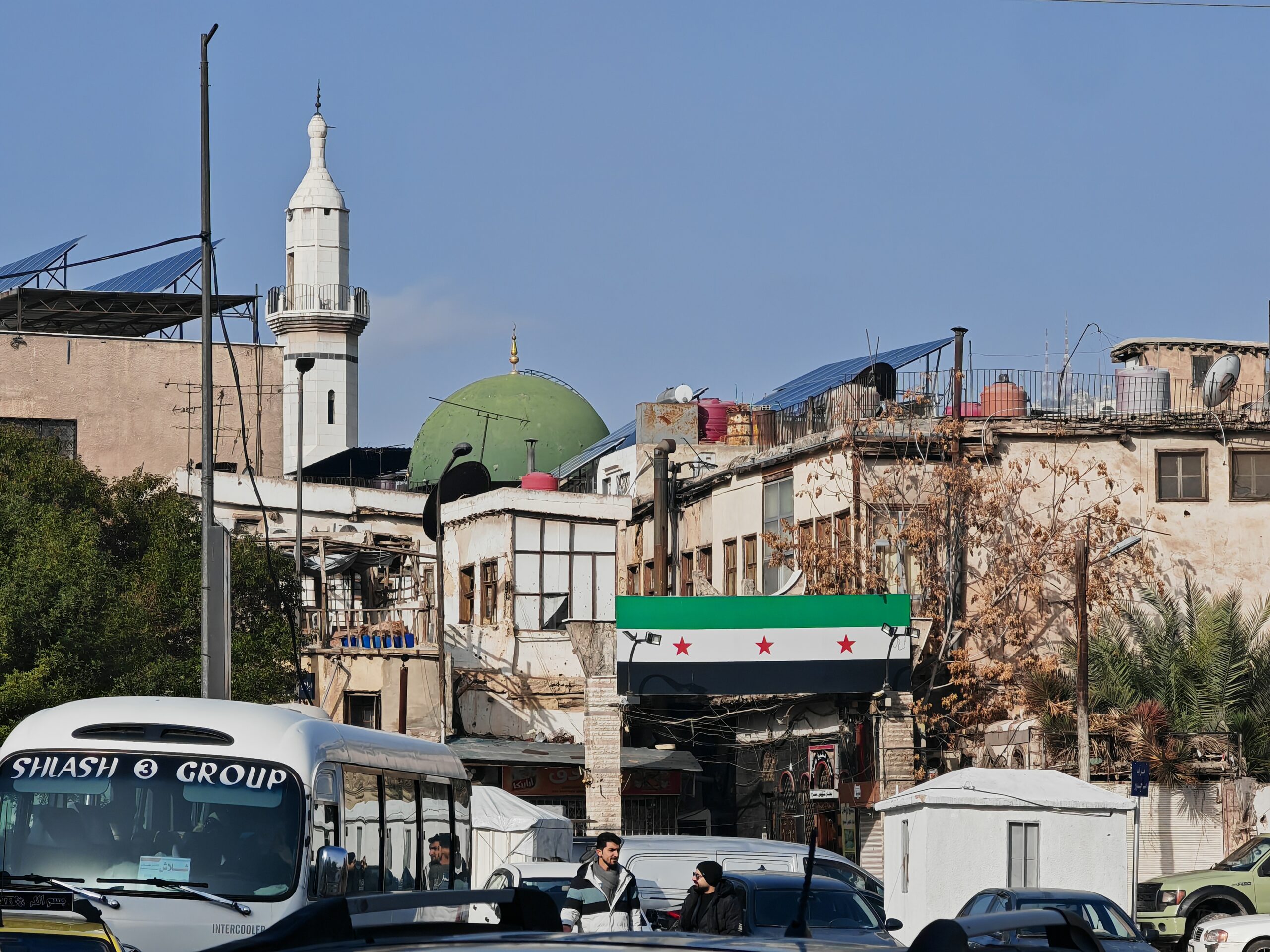
Dilapidated, neglected buildings, hardly functioning services, a sense of being cut off from the outside world – and a pervasive feeling of liberation and budding hope. This is Damascus, eight months into the new government of national liberation, conceived in Idlib, that swept the country with its shock troops and ended the Assad dynasty’s rule.
Decades of war, sanctions, and isolation have left their mark on the world’s oldest city. But unmistakably, a cautious sense of optimism is creeping into the eerie landscape. In the basements and on the ground levels of dilapidated residential buildings, a myriad new small enterprises raise their heads or chug on with new vigor. Damascenes are traders and businessmen second to none, not even their Lebanese neighbors, who invented money. They survived five decades of repression and two of almost total isolation, and now, with sanctions gradually lifting, are no longer denied the oxygen to thrive. True, money is scarce, and the rules are still in the making, with an uncertain legal landscape hard to decipher. Still in their formative stages, it is difficult to find your way in the maze of new institutions. But never mind the constraints, Damascus, if not the whole of Syria, is unmistakably coming back to life.
What will the new Syria look like? Those who hold the answer to the question are first and foremost the men who waited pent up in Idlib for years under ferocious aerial bombardments and fended off renewed assaults by the Government army bent to break them. Led by HTS, a one-time jihadist outfit breaking ranks with Al Qaida in Iraq and reinventing itself as a Salafi armed liberation movement in Syria under Ahmed Al Sharaa aka Abu Mohammed Al Jolani, the Idlibis hold the levers of power in the new Government, claim observers. The picture, however, is more nuanced. Idlib did not relocate to Damascus lock, stock, and barrel. President Al Sharaa, a man issued from a conservative, but intellectual background – his father was a petroleum engineer and long-time resident of Saudi Arabia, where Al Sharaa was born – has, by all indications, understood the call of the times. Not intent to Talibanize Syria, he formed a government containing, but not exclusively manned – and even wo-manned – by onetime jihadists. A multifaceted, if not rainbow, cabinet including returnee technocrats at the head of the new Syria was an indication for both inside and outside that the new system wants, at least on the level of intent, to work for all Syrians.
But make no mistake: do not think for a moment that the new Syria will resemble freewheeling Lebanon. Enjoying the overwhelming support of a majority Arab Sunni Muslim society, the new system will compromise only so much when it comes to principle. Inclusivity, yes, but giving up on principle, no. For decades, the Islam that most Syrian Arabs prefer to cultivate, conservative in tenets as much as symbolism, was under immense pressure from a repressive government that mascaraded as secular but in reality was sectarian to the hilt, cultivating a rule founded on the exclusivity of its own minority Shiite sect and bolstered by Iran bent on claiming Syria for Shiism. The pent-up anger and frustration of the people with a regime that tried to blot out their identity and thrashed them in an unending series of blood baths – in Aleppo and Hama in the eighties, and all over Syria after the Arab Spring uprising of 2011 – is now breaking to the surface in so many forms. Sporting beards as a sign of loyalty to the new world in Syria has become pervasive among men. The stalls in Al Hamidiyya, the capital’s iconic bazaar, sell a plethora of items symbolic of liberation – the new green-white-black flag and all imaginable items of clothing decorated with the new seal of arms of post-Assad Syria – along with ISIL symbols and paraphernalia. Your choice, in this new world of freedom. The most telling items are, however, the Assad stockings, with the ousted dictator’s portraits on the sole. Not unlike the symbolism you encounter at Damascus Airport, where passengers walk over a rug featuring the former president’s portrait.
A conservative new Syria may not be unlike many other Arab countries that proudly profess Islam as their core and fundamental identity, laid down in their constitutions. What remains to be seen if such an approach will provide solace for the minorities of Syria, who do not identify as Arab or Muslim. Will they have a place in the new Syria?
Maybe yes. Damascus might serve as a case in point. The one-time Christian quarter of Bab Touma, now with a mixed population living, as one can observe, cheek to jowl in complete harmony, is an encouraging indication. True, the quarter has already witnessed a bloody attack against one of its millennial churches claiming a dozen lives, perpetrated by ISIL elements, much the same way it happened in Iraq emptied of its Christian minority by terrorism. Rogue elements of the army and high places were found to be responsible for planning and executing the massacre, and it will be instructive to see if anyone will be indicted, even more so, brought to justice. Still, the atmosphere of Bab Touma exudes peace and harmony, people going after their daily business, dozens of cafés and restaurants overflowing with clients, and even the odd (elsewhere in Damascus) liquor shops open to business. The quarter is strictly guarded against rogue infiltrators by the state security – judging by their appearances, some probably veterans of Idlib.
With the conflicts at the fringes, the new Government in Damascus has to find a speedy solution to the brewing trouble in Suweida and has to implement a compromise on and off owned and disowned by the Kurds of the northeast, under the sway of the Qasd party led by Mazloum Abdi. Two challenges hardly felt in Damascus but hanging like a pall over Syria. Restoring peace to the country and rebuilding confidence in one another is a tall order, but it is inevitable to see the country take off. The fate of the returnees is one other monumental challenge. Millions fled and stuck abroad, willing to restart their lives at home, face legal hurdles as their homes and lands, confiscated by the former government, are now with new owners, the government cannot summarily evict – lest it creates new refugees. The country still uses the inflated currency inherited from the dictatorship, which takes stamina to use, or even carry, with the three- and four-digit paper money hovering around ten thousand to the dollar. Formerly printed in Russia, the new currency will come from Germany, so the story goes, finally ending the misery of dealing in the Assad banknotes.
Donors and prospective partners for the Herculean task of reconstruction must take stock of the realities and draw up fair but uncompromising conditions on what they expect of the new Government. They need to be judicious. Syria badly needs and fully deserves assistance for reconstruction in order to become a peaceful and stable country at harmony with itself and its neighbors. Without diktats but with clear caveats, the new Government must be guided, and if need be, held accountable over the fate of all its citizens, regardless of ethnicity, religion, or sect.
It may take a lot of restraint for the many out of Idlib who risked life and limb to rid Syria of its odious dictatorship to compromise on a worldview rooted in exclusivity. But Damascus is not Idlib, and its air of tolerance and inclusivity, unbroken even by five decades of repression, must teach the lesson to the newcomers from Idlib. Syria can be conservative, but it is still a home to all its people. In the Via Recta of Bab Touma, where St. Paul walked one day, churches and mosques stand side by side for centuries and will for centuries to come. Rebuilding Syria starts in Damascus and must rely on the spirit of this timeless city, where cultures and religions formed an eternal bond.