For decades, Iran’s cultural heritage was untouched by the destruction that affected other parts of the Middle East. Unlike other parts of the region, Iran and its heritage were not damaged by either conflict or the destructive ideology of armed groups. That changed in 2026, when for the first time since the Iran–Iraq War, some of the country’s most important historic monuments found themselves exposed to the realities of modern warfare.
Iranian History and the 2026 War
Unlike during previous episodes of destruction of heritage, in the 2026 war, the heritage was not a target, despite President Trump’s 2020 claims that cultural sites are among fifty-two identified targets in Iran, or his 2026 threats about wiping out the whole civilization. During the 2026 war, most of the damage recorded in Iran resulted from airstrikes, missile attacks, and shockwaves, which damaged several of Iran’s historical monuments, including UNESCO World Heritage Sites.
The first internationally documented case occurred on 2 March 2026, when a strike on Tehran’s Arg Square damaged the nearby Golestan Palace. UNESCO reported that the World Heritage Site was affected by debris and shockwaves generated by an airstrike within the palace’s buffer zone. Subsequent photographs and assessments revealed shattered mirrorwork, broken windows, damaged woodwork, and destruction of decorative elements within the Qajar-era complex. The damage was particularly significant because Golestan Palace is Tehran’s only UNESCO World Heritage Site and one of the most important symbols of nineteenth-century Iranian statehood and architecture.
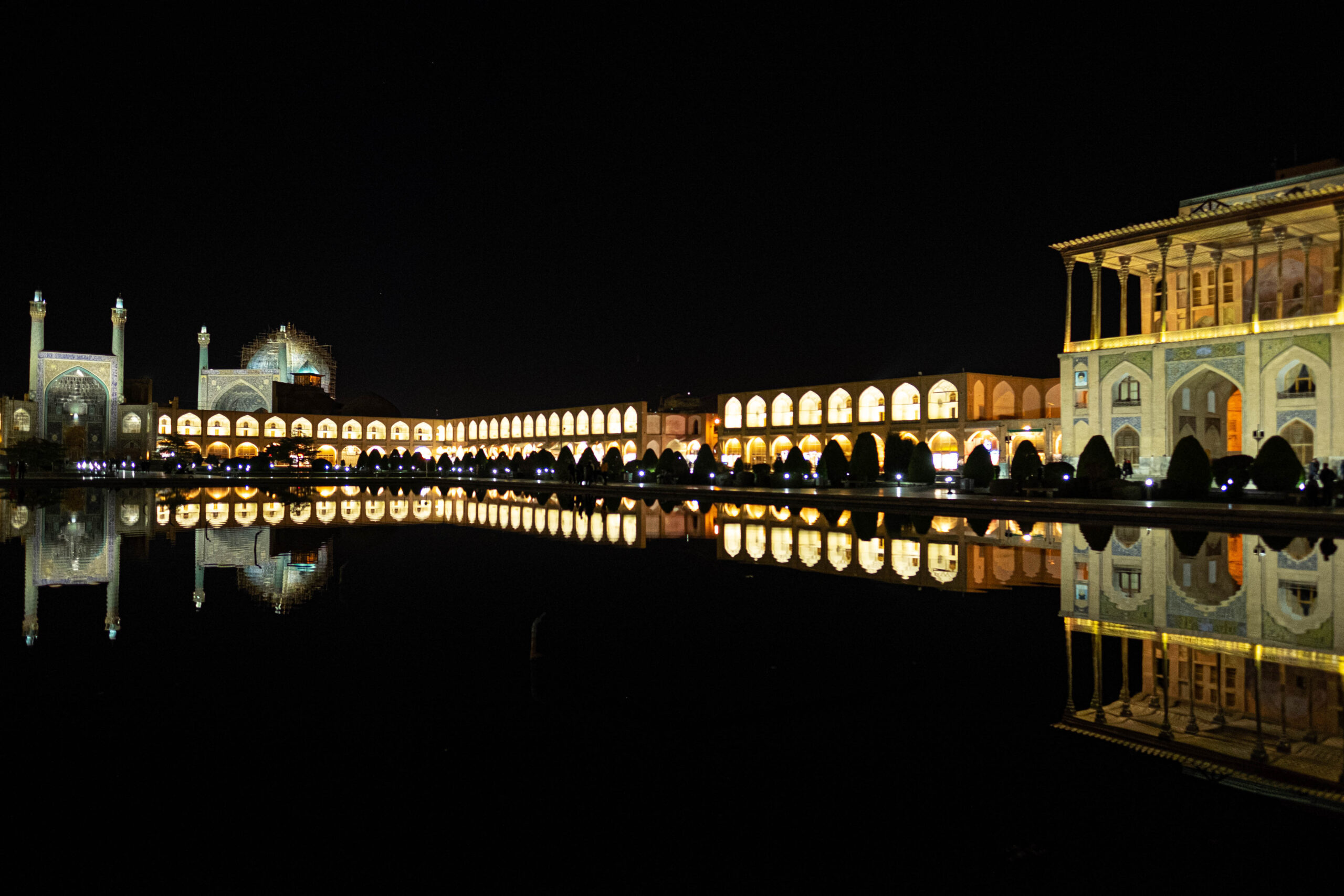
A week later, the historic city of Esfahan suffered some of the most extensive cultural losses documented during the conflict. Airstrikes carried out on 9 March in the vicinity of government and military facilities generated damage across the historic urban center. Among the affected monuments was Naqsh-e Jahan Square and several adjacent monuments, such as Chehel Sotun. Another major site affected by the conflict was the Jameh Mosque of Isfahan, whose architectural development spans more than a millennium. Reports indicated damage caused by nearby explosions and shockwaves, particularly to architectural elements surrounding the square.
Overall, Iranian authorities reported that airstrikes and shockwaves damaged over 149 historical and cultural sites in eighteen (some say in twenty) provinces. Besides the UNESCO-listed monuments mentioned, Iranian authorities reported that Tehran’s historic Grand Bazaar suffered structural and decorative damage, as did Falak-ol-Aflak Castle in Khorramabad, a major Sasanian-era fortress marked with the Blue Shield emblem used by authorities to identify protected cultural property during armed conflict. In the same area, airstrikes and bunker buster bombs also destabilized the prehistoric valley, but more information is inaccessible at the moment. According to Iran’s deputy cultural heritage minister, Ali Darabi, in a statement on May 17th, Tehran sustained the most significant losses, with up to 70 historical landmarks and museums affected. The Ministry of Cultural Heritage, Tourism and Handicrafts estimated damages at roughly $49 million.
It is important to note that it is most probable that not every damaged historical place made it to the list.
Everyone who has visited Iran knows how deeply integrated historical neighborhoods are into modern cities. The Iranian historical landscape is not created by monuments, palaces, mosques, and rich merchant houses, but by the context in which they are situated. By old streets, squares with nakhlas covered by heavy black tissues, hidden doors bringing visitors to zurkhaneh trainings, or steep stairs descending toward a well. The conflict we witnessed has a destructive influence on the historical landscape in one of the most ancient cradles of civilization and can easily wipe out parts of human memory, as has happened elsewhere in the region, such as in Afghanistan, Syria, and Iraq, for instance.
In Iran, the destruction of cultural heritage, which is interconnected with national identity and pride, might as well have a deep impact on the local population.
Iranian History and the Islamic Republic
The Islamic Republic’s approach to cultural heritage cannot be understood solely through the lens of conservation policy. Since 1979, historical sites and public spaces have served as important arenas in which the state negotiates its own identity and legitimacy. Heritage preservation is intertwined with ideology, memory politics, and nation-building.
At the heart of this approach lies a fundamental tension. The Islamic Republic emerged from a revolution that rejected the Pahlavi monarchy and its state-sponsored glorification of pre-Islamic Persia. Yet the new regime inherited a country whose history extends far beyond Islam and whose most famous monuments include the remains of glorious empires. Rather than abandoning this pre-Islamic heritage, the Islamic Republic gradually incorporated it into an official narrative that presents Iranian history as a continuous civilizational story culminating in the Islamic Revolution. In this interpretation, ancient Persia, Islamic civilization, Shiʿism, and the revolutionary state become successive chapters of a single national trajectory. This allows the regime to claim both religious legitimacy and ownership of Iran’s broader historical legacy.
In the first place, sites associated with Shiʿi Islam, religious scholarship, pilgrimage, and the revolutionary period occupy a privileged position because they directly reinforce the foundations of the state. At the same time, the state has invested heavily in preserving major pre-Islamic monuments such as Persepolis, Pasargadae, and Susa. However, according to Mozaffari, these sites are generally presented not as symbols of an alternative national identity but as evidence of the antiquity, greatness, and continuity of the Iranian nation.
Public space, which includes heritage and cultural sites, plays a particularly important role – it is clean, well-maintained, and provides visible evidence of state stewardship and cultural investment even at times of difficulties that might dominate public attention. In this sense, heritage becomes a resource through which the state cultivates attachment to place, encourages civic pride, and demonstrates its own capacity to care for the nation and its legacy. This forms part of a strategy through which the state seeks to generate legitimacy by improving everyday environments and linking contemporary governance to narratives of historical continuity, cultural sophistication, and national achievement.
Why is this relevant to the 2026 war?
For the government, the affected monuments are not merely archaeological remains or tourist attractions but hold ideological importance through which the state articulates its narratives. Damage to these sites represents both a cultural loss and a challenge to one of the resources through which the Islamic Republic constructs its understanding of Iranian identity. On the other hand, it can easily become a part of its propaganda in which the state figures as a protector of the past. Propaganda or not, the destruction of cultural heritage has a strong effect on Iranians, who can see their past, public space, its gardens and memorials, which form the backbone of local social life and urban identity, burn in a live broadcast. The destruction of shared symbols of national pride, along with a direct and new experience of war, can therefore have a deep influence on the Iranian public and their opinions.
In the context of the MENA region, Iran is unique in the depth of its perception of national identity and its inextricable connection to history, which spans both pre-Islamic and Islamic eras. For the future, heritage is likely to remain a factor in shaping both political discourse and popular attitudes in Iran. As different actors compete to define the country’s identity and trajectory, interpretations of the past will continue to influence debates about nationalism, religion, governance, and Iran’s place in the world. Cultural heritage may therefore become not only a subject of preservation but also a resource through which Iranians articulate political aspirations, social values, and visions of the nation’s future.
Image: Author