The Gulf states seek alternative options to increase the level of transport safety in the turbulent region. The emerging railway network appears to be a promising sector that complements aviation. Although there are positive signs of deeper cooperation in developing a cross-border railway network, aviation remains the competitive field that will further encourage the Arab Gulf states to pursue their ambitious visions and strengthen their position as global transportation and logistics hubs.
In contemporary scholarship, the logistics and transport infrastructure of the Gulf Cooperation Council states has emerged as a significant area of analysis. This is hardly surprising, given the accelerating pace of infrastructure development undertaken by the Arab Gulf states, such as the recent inauguration of passenger services by Etihad Rail in the United Arab Emirates and the realization of cross-border railway projects in the Gulf. These efforts strengthen their role in regional transport corridors and broader connectivity.
For instance, Clemens Chay claims that while the Middle East remains divided, Gulf States are using transport, infrastructure, and digital networks to turn connectivity into geopolitical influence. In another article, Cavit Emre Aytekin uses the term ‘infrastructure diplomacy’ and argues that it can both strengthen regional interdependence and intensify rivalry; however, it depends on how infrastructure projects are governed. Aviation is a particularly relevant example, as it is widely used not only to promote a country’s image but also to facilitate bilateral relations and boost economic growth.
Saudi Arabia, the United Arab Emirates, and Qatar have emerged as leading states across aviation, railways, and maritime, although each sector is at a different stage of development. The role of the other countries should not be overlooked, particularly Oman, whose importance in international maritime trade has also grown significantly, with the port of Salalah ranked 50th among the world’s largest container ports, following Dubai, Abu Dhabi, and Port Said. The policies of these states are closely aligned with their respective flagship development strategies, such as Saudi Vision 2030, Emirati ‘We the UAE 2031’ and UAE Centennial 2017, and Omani Vision 2040, as well as complementary, sector-specific strategies that support their strategic objectives.
At the same time, these initiatives also carry a broader, distinct geopolitical dimension, particularly given current regional circumstances. The U.S. and Israel’s war with Iran has deeply affected the local infrastructure and led to total disruption of the aviation sector across the Middle East. The blockade of the Strait of Hormuz has compelled the Gulf states to develop alternative routes for exporting energy resources.
This topic was discussed at the recent Hili Forum in Abu Dhabi, which gathered prominent decision-makers, diplomats, and scholars. On the first day of the event, Dr Anwar Gargash, senior diplomatic adviser to the UAE President Sheikh Mohamed bin Zayed, stated that the UAE seeks alternative ways to increase the country’s security and ensure its steady economic growth despite the current circumstances. Port capacity, pipelines, railways and corridors to export goods are amongst the options that have been undergoing the process of development for the past couple of years. As the diplomat underlined, “our energy exports will not be held hostage, nor will our trade and economic activity”.
Above all, these strategic approaches to infrastructure development demonstrate the growing ambitions of their political leadership, turning them into a broader competition for a leading position not only at the regional level but also on the international stage. This, in turn, further intensifies the long-standing economic rivalry between the major regional players, namely the UAE and Saudi Arabia, which extends beyond connectivity. In this article, railway and aviation serve as the two main areas of analysis, with particular attention paid to the impact of systemic pressure on the implementation of planned projects and the operation of these sectors.
Expanding Railway Networks
The GCC Railway is a prominent project that was initiated in 2009. The planned route, connecting all six countries spanning from Kuwait City to Muscat, is expected to reach nearly 2,117 km and be fully operational by 2030. The Arab News reports that 50% of the project is complete and will include both freight and passenger services.
Beyond the broader regional initiative, the Arab Gulf states have acknowledged the importance of developing domestic railway networks to complement and connect with emerging projects in neighboring countries. Starting with the UAE, Etihad Rail commenced its passenger services at the end of June 2026, connecting all seven emirates and eventually 11 cities within their borders, spanning from Al Sila’ (Abu Dhabi) to Fujairah. At the time of writing, not all the stations are open yet. The network is being launched in stages, with the remaining stations, including Dubai and Sharjah, opening over the coming months.
Spain provided its passenger trains – CAF – as well as China with their high-speed passenger diesel multiple units. Several Chinese enterprises, alongside entities from Japan, South Korea and European countries, were involved in providing engineering, construction, electrical and railway systems services for Etihad Railway. This project aligns with the UAE Railway Program, which aims to reduce carbon emissions by almost 80% over the course of 50 years.
The UAE has been cooperating with Oman in developing Hafeet Rail, which also encompasses freight and passenger services. The project, officially launched in 2024, is planned to connect Abu Dhabi to Sohar Port in Oman via other Emirati cities in the east. Three entities have been involved in the construction and development of the 238-kilometre route – Etihad Rail, Oman Rail and Mubadala. The Hafeet Rail, which is 40% complete, intends to facilitate the regional logistics ecosystem, thereby contributing to the economic development of both states and their bilateral relations. Oman authorities pursue the major ‘Vision 2040’ with an aim to diversify away from hydrocarbons; therefore, they consider the railway development crucial to connect industrial zones, ports, and logistics centers.
Saudi Arabia has also boosted its railway network over the years, connecting several cities across the country. As the largest GCC country by land area, it needs multiple transportation options. Currently operational rail connections include: the Haramain High-Speed Railway that links Mecca and Medina through King Abdulaziz International Airport (Jeddah) and King Abdullah Economic City; two connections between Riyadh and Dammam, including the one operating freight services; and the North-South Line, a 2,750-km network of rail lines which offers freight and passenger operations between Riyadh and Al-Haditha, a city located on the border of Jordan, and Riyadh and Jubail in the Gulf. Saudi Arabia Railways (SAR), the main body managing and operating the Saudi rail network, is currently undertaking the implementation of a new project, the Saudi Landbridge, with an estimated length of 1,500 kilometers connecting the west with the east – specifically Dammam, Jubail, through Riyadh, with Jeddah located on the Red Sea.
Saudi ambitions are not limited to domestic projects; they extend beyond its borders, with a growing focus on other Middle Eastern countries. Starting with the closest proximity, in December 2025, the Kingdom signed an agreement with Qatar to construct a high-speed rail line that would connect Riyadh with Doha and their airports. Al Jazeera also reports the plan envisages that the 785-kilometer-long route will be completed in six years, with an estimated 10 million passengers to be served per year. Another part of the broader GCC Railway project is the Saudi-Kuwait rail link that will connect their capitals. The 111-kilometer-long Kuwaiti section of the link will extend from Shadadiyah to the Saudi city of Nuwaiseeb, located on the border, which accounts for 5% of the wider GCC rail lines.
According to media reports, in June, Saudi Arabia and Türkiye signed a Memorandum of Understanding to commence cooperation in logistics and railways. In this regard, both sides are planning to develop a railway that will include transport of goods, hydrocarbons, and passengers. They also anticipate extending the project to other countries, including Syria and Jordan, in the future.
Aviation Hubs in the Gulf
It is no wonder that the Gulf is considered one of the key global hubs, given the large number of passengers passing through the airports every year. According to Airports Council International, Dubai International Airport was the second-busiest airport in the world in 2023-2025, with passenger numbers increasing year by year from 87.05 million to 92.32 million and 95.19 million, respectively. The UAE is the only Gulf state that appeared amongst the world’s leading airports in terms of global passenger traffic.
If we consider the total seat capacity, which is the total number of passenger seats offered on scheduled one-way flights during a certain period, there is a slight change in the position of the Gulf airports in the world ranking. OAG reports that in 2025, Dubai International Airport ranked first globally, while Hamad International Airport in Doha ranked 10th, with airlines offering 62.43 million and 32.69 million seats on scheduled international flights, respectively. IATA has also presented interesting data regarding the busiest airport pairs. In 2025, Jeddah-Riyadh was listed as the 5th busiest pair in the world, with 7 million passengers passing through these airports.
As noted, airports can play a vital role on both the domestic and international stage. However, given the long-term ambitions of decision-makers in the Arab Gulf, these numbers are likely to increase over time, in line with the strategic visions that include infrastructure development and national airlines.
Some of the Gulf states have already announced plans to expand airport capacity. In 2024, media outlets reported that Al Maktoum International Airport in Dubai will become the world’s largest airport and increase its capacity to 260 million passengers. It is worth noting that the UAE is not the only state to perceive itself as one of the aviation hubs globally; Saudi authorities similarly view the Kingdom as occupying a strategically important position within the global transport and logistics network. As stated in the National Industrial and Logistics Program, Saudi Arabia aims to boost passenger numbers to 330 million by 2030 across the country’s airports. A similar approach applies to air cargo, with the Saudi authorities seeking to increase cargo-handling capacity to 4,5 million tons. Oman, on its part, is taking similar steps to develop its aviation sector. Following the aviation strategy, Muscat aims to accommodate 40 million passengers annually by 2030. Omani authorities, benefiting from the state’s strategic location, see an opportunity to develop airports and turn them into passenger and cargo aviation hubs. These efforts are complemented by an increase in the number of international flights. This process is best captured by Oman Air’s inclusion in the Oneworld alliance, which opens the door to over 900 destinations.
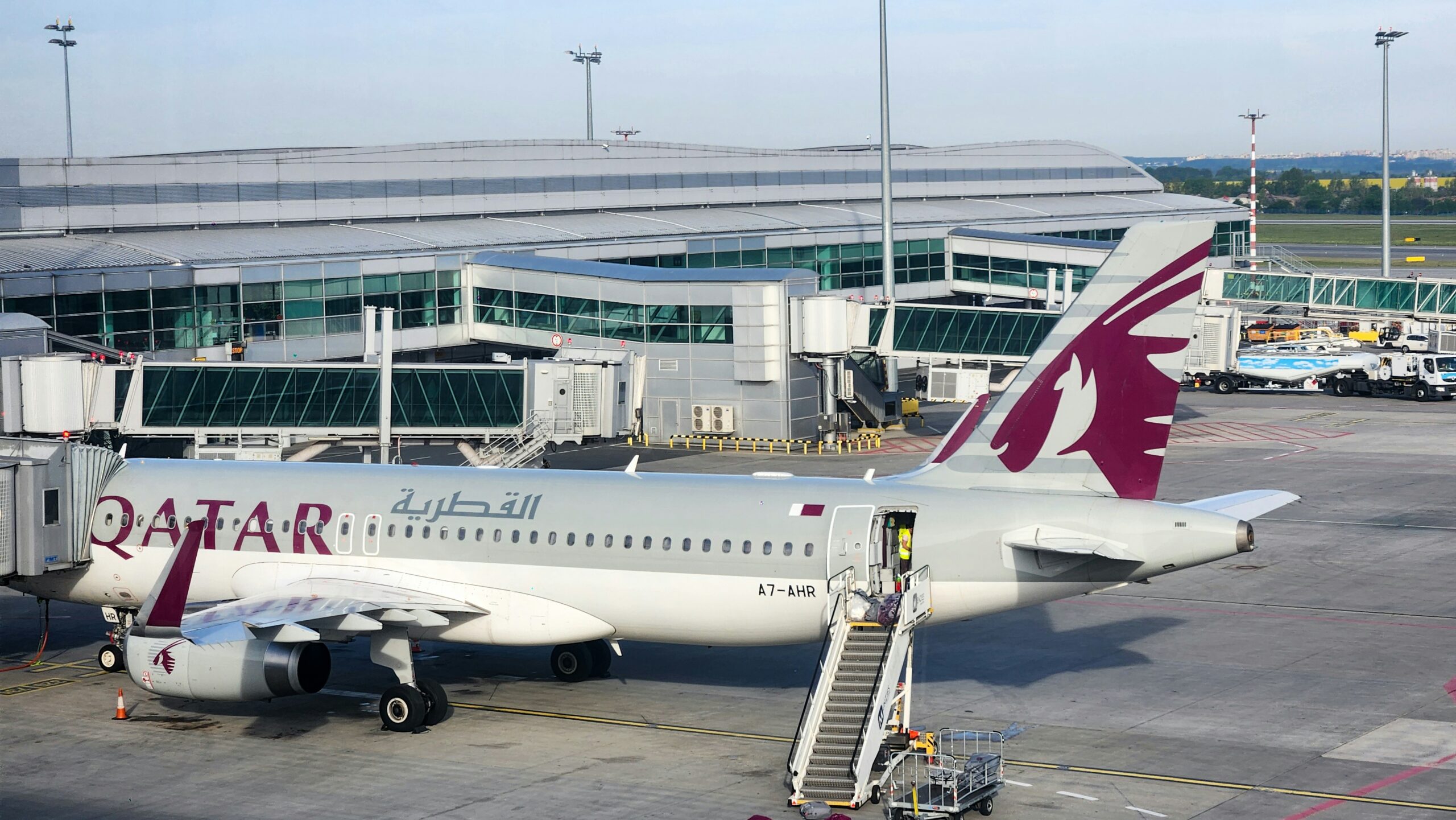
Finally, the discussion must also include the role of national airlines, which are all tools to shape the country’s image and carriers of culture and identity, as they often showcase the national flags and symbols on the fleet. For the ninth time, Qatar Airways maintained its leading position in the “World’s best airline” ranking. In 2025, only four Middle Eastern airlines were in the top 20, including Qatar: Emirates (4), Turkish Airlines (6), and Saudi Arabian Airlines (17).
A new air carrier has recently emerged in the Middle Eastern market. Launched in 2023, Saudi Arabia’s Riyadh Air, with a constantly expanding network of destinations and fleet, has the potential to make a major impact on the aviation industry. The airline is owned by the Public Investment Fund, and it is a part of the broader Vision 2030 to accelerate the Saudi’s transformation into a global aviation and logistics hub. Riyadh Air is operating domestic and international flights – it currently flies to nine countries with the prospect of increasing the number to 100 by 2030.
With the ongoing war in the Middle East, the aviation market remains alert. As the data shows, this situation has adversely affected the airline industry. As John Grant, reporting for OAG, states, when comparing data from May to the February baseline, most of the prominent full-service and low-cost regional airlines such as Air Arabia, Qatar Airways, and Flydubai saw capacity drop by 34,3%, 32,4% and 28,2%, respectively; meanwhile, the Qatari airline also incurred losses in June. Shortly after, the aviation market saw a gradual restoration of services and returning airline capacity. However, as the situation remains unstable and peace is nowhere on the horizon, the industry remains prepared for unforeseeable developments.
Observations
Today, the term ‘interconnectivity’ has gained more attention in the ongoing discussion on how to build resilience in turbulent times. For any state in the Middle East, it is very important to increase its security in a broader sense, meaning that the main objective is to ensure the safety of passengers and the transport of goods, as well as maintaining the safe passage of resources. With the strategic plans on the agenda, the Gulf states embarked on a path to cooperate in developing railway lines, which indicated their efforts to complement other means of transport by accommodating the increasing number of tourists in particular Gulf states, and to adapt to emergencies, which unfortunately occur very often and also affect transport services. This nevertheless suggests a degree of unity in this respect and does not suggest any competition, at least in this particular area.
This phenomenon does, however, emerge in the context of aviation. For years, the Middle Eastern airlines, namely Qatar Airways, Emirates, Etihad, and low-cost air carriers such as Flydubai, held the position of best-performing in terms of quality and safety. Today, airlines are expanding their range of services and destinations to strengthen their competitive position; however, with the emergence of new air carriers, this situation can also affect their position in the long-term perspective. The Gulf states aspire to become major aviation and logistics hubs, and these may constitute the main incentives for increased competition.
On the other hand, competition is a process that can drive the economic growth of the Gulf states. As a result, it also contributes to attracting foreign direct investment and diversification of strategic partnerships. As the data above shows, Dubai International Airport ranks among the world’s busiest airports and is the busiest in the Middle East. This, in turn, suggests that its position is unlikely to change in the years to come. It remains to be seen whether Saudi Arabia will reach the same level of passenger capacity in the coming years and become competitive with its neighbor; however, if this occurs, it will further strengthen the position of the Gulf subregion as one of the most important transportation hubs, particularly in terms of air connectivity.
Certainly, it is a challenging chapter in the Middle East’s history, but with a clear vision and integrated response to the current disruptions that can also hinder the development of the transport sector, it will be significantly easier to manage the ongoing processes and adapt national strategies to the long-term shifts in security architecture and economic landscape.