For the last four days, heavy clashes between Iranian security forces and Iranian Kurdish opposition parties in different areas near the border have occurred, leading to casualties on both sides. The key question is whether this signals the start of a new Kurdish military offensive.
According to Hengaw, two armed clashes broke out on the evening of Wednesday, July 1, 2026, in the cities of Piranshahr and Sardasht between an Iranian Kurdish opposition party and the Islamic Revolutionary Guard Corps (IRGC). So far, little is known about the clashes in Sardasht, and the Kurdistan Free Life Party (PJAK)’s armed wing said it was not involved in the incidents.
“PDKI can confirm that six, not five, Peshmerga of the Democratic Party of Iranian Kurdistan were killed in a clash with IRGC forces near Piranshahr, in Iranian Kurdistan. According to our information, they were on a political and organizational mission when they were ambushed by a large and heavily equipped IRGC force,” Hejar Berenji, the U.S. Democratic Party of Iranian Kurdistan (PDKI), told Khayrion.
Berenji underlined that the clashes are not a response to recent U.S.-Iran peace talks. “The Kurdish struggle for freedom, democracy, and national rights existed long before the current talks. What we are seeing is the continuation of the Islamic Republic’s repression against Kurds, both inside Iran and through repeated attacks on Kurdish civilian camps in Iraqi Kurdistan.”
“PDKI does not seek chaos. We seek a democratic, secular, pluralistic, and federal Iran. But Kurdish communities also have the right to defend themselves against IRGC repression and attacks.”
Furthermore, one 19-year-old Kurdish man, identified as Siavash Alak, was fatally stabbed following an attack by a group affiliated with the pro-Iranian government militia Basij in the Kurdish town of Mahabad. The killing has sparked widespread public outrage, nighttime protests, and a general strike across the city, where the situation is still tense, and there is an ongoing militarization.
The clashes erupted around two weeks after Iran and the United States signed a 14-point Memorandum of Understanding (MoU) on June 17 to end hostilities after 40 days of U.S. and Israeli aerial attacks on Iran between 28 February and April 8. During the 40-day war, there were many reports suggesting the U.S. and Israel might back a Kurdish cross-border offensive, but this never materialized.
The initial clashes started when Iran launched three suicide drones targeting PJAK on June 25 in Baneh, to which PJAK’s armed wing said they would respond. After the Iranian drone strike, events escalated.
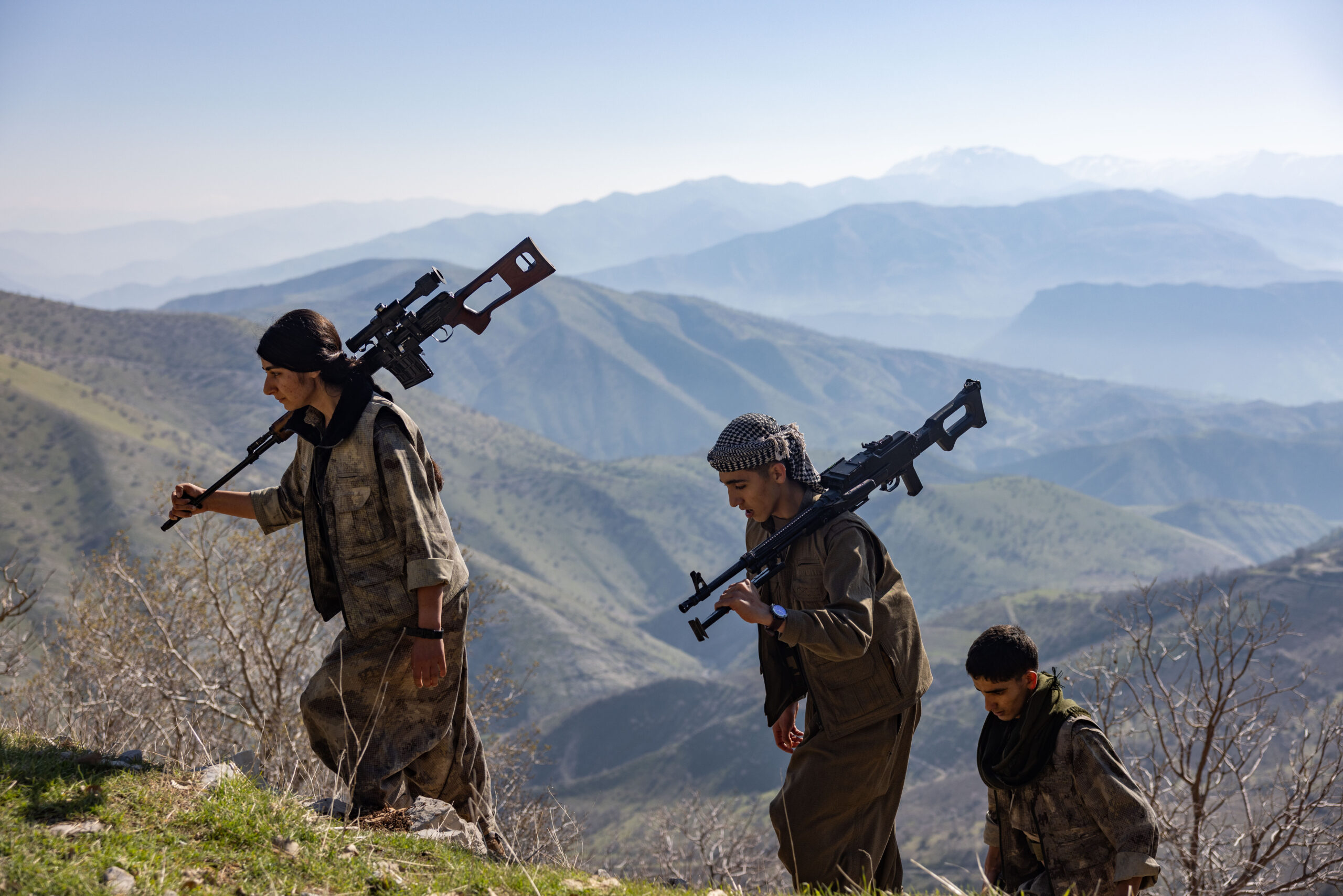
According to a report published by the Kurdish human rights organization Hengaw on June 30, clashes in several cities have left at least seven people dead, including three Iranian military personnel and four PJAK guerrillas. The PJAK’s armed wing also confirmed that four of its fighters were killed on June 27 near Mahabad. In the statement, the PJAK’s armed wing underlined that they have not carried out any attacks against the Iranian regime in recent months, underlining their neutrality. The statement noted that the PJAK had not even attacked when Iran was in its weakest situation (during the 40-day war). Furthermore, two high-profile Kurdish members of the IRGC-linked Basij were gunned down on Monday night in Paveh, Kermanshah province.
The PJAK’s spokesperson, Rivar Abdanan, on June 30 blamed the IRGC for the clashes in Mahabad and Paveh.
“Any attack against the Kurdish people and PJAK forces, the exercise of the right to self-defense by both the East Kurdistan Defense Units (YRK) and self-organized local popular forces is considered entirely legitimate and justified,” he said.
So, in four days, a total of 10 confirmed Kurdish fighters have been killed in the recent clashes since June 27.
During the 40-day war, Iranian Kurdish parties before and after the 8 April ceasefire faced hundreds of drone and missile attacks in Iraqi Kurdistan that have continued until today and have resulted in the loss of the lives of 9 members of Iranian Kurdish parties. Underground camps of PJAK were not targeted during the drone attacks, as I wrote before.
Read More: Why PJAK Has Largely Escaped Iran’s Attacks in Iraqi Kurdistan
With the increased clashes inside Iran, it is unlikely that these drone attacks will stop. Moreover, Iran assassinated a member of the Kurdistan Freedom Party (PAK) in a hotel in the Kurdish capital of Erbil in Iraqi Kurdistan on June 27.
On Thursday, July 2, the Islamic Republic once again carried out a drone strike against positions of the PDKI in the Balisan Heights in the Kurdistan Region of Iraq. The day before, Iranian drone strikes also targeted the PDKI’s Degala camp near the town of Koya and a PAK base on the outskirts of Erbil.
The question is whether the current armed clashes indicate a new Kurdish offensive.
“I find it difficult to view these recent clashes as the beginning of a sustained offensive,” Shamal Bishir, political analyst and a former member of PJAK, said. “The high casualty rate among the Kurdish forces has been striking, highlighting their operational limitations and raising doubts about their ability to maintain a prolonged military campaign.”
In several statements, PJAK officials also emphasized that their operations were in self-defense.
Aso Saleh, a Kurdish political analyst with links to the PDKI, also emphasized that this is not a sign of a new military offensive and that armed and civil resistance within the country remain the two fundamental pillars of the Iranian Kurdish opposition parties.
“As we repeatedly emphasized throughout the 40-day war, it was not our war. Likewise, this ceasefire and any potential peace agreement are not about us,” he said.
“Our party represents a movement in Iranian Kurdistan that exists independently of any war or peace involving the Iranian regime. That said, any conflict that weakens the regime may also create opportunities that benefit our cause.”
“Whether through our underground organizational network, our urban Peshmerga units, or our Peshmerga forces across Kurdistan, we have always maintained a presence in the cities and villages of Kurdistan. In some instances, the increased militarization of the region or the expanded presence of our forces may have resulted in clashes. However, this should not be interpreted as the beginning of a new military phase,” he concluded.
Image: Afshin Ismaeli