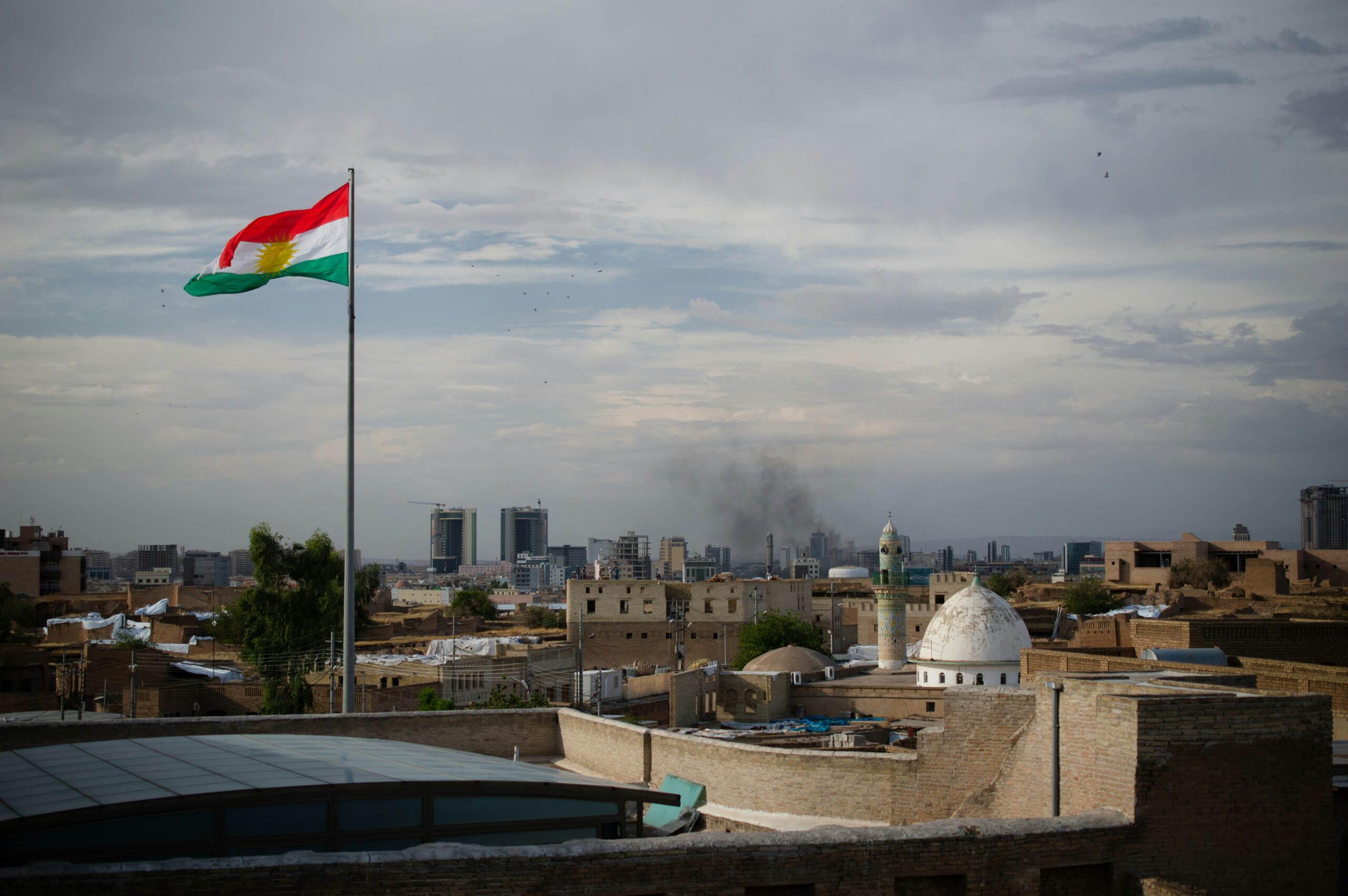
With ongoing Iranian drone attacks on the Kurdistan Region, and Coalition forces leaving by 30 September 2026, it remains to be seen if attacks on the Kurdistan Region will continue after September.
Iran’s Targets in the Kurdistan Region
Among Iran’s targets are the various Iranian Kurdish opposition refugee camps and bases in the Kurdistan Region, most of whose parties were exiled from Iran in the 1980s. For instance, in mid-September, camps of the Iranian Kurdish opposition groups Kurdistan Freedom Party (PAK), Kurdistan Democratic Party of Iran (PDK-I) and Komala were targeted by missiles and drones.
Rudaw also reported on August 31 that the Kurdistan Region between August and February was targeted with 983 drones and missiles by Iran and Iranian-backed Iraqi factions. As a result, 32 people have been killed and 156 injured, the majority, 20 of them, members of Iranian Kurdish opposition parties. Furthermore, on 23 March, six members of the Iraqi Kurdish Peshmerga forces were killed in Erbil’s Soran district. The data show that only two or three civilians were killed in the attacks, while out of 156 injured persons, only 18 were civilians. However, it should be noted that many injuries caused to civilians were not reported in the media.
At Erbil International Airport, the attacks killed one Kurdish airport security employee and one contractor in March, as well as one U.S. soldier in July. Also in March, one French soldier was killed at a Peshmerga base near Makhmour. On the outskirts of Erbil, an off-duty Peshmerga and his wife were also killed in April.
According to Rudaw data, most of these attacks targeted Erbil province (677 attacks), which is logical since Erbil offers several targets for Iran. These include the U.S.-led Coalition forces operating at the Erbil Air Base. Moreover, Erbil is home to the $800 million U.S. Consulate General building, the largest U.S. consulate in the world. The Consulate building itself was damaged during the war. Iranian Kurdish opposition parties are also present in Erbil, including in Koya. On August 17, two explosive-laden drones targeted the private office of Kurdistan Regional Government (KRG) Prime Minister Masrour Barzani and the residence of the head of the Kurdistan Region’s Security and Intelligence Agency in the Erbil Governorate. President Masoud Barzani said in late March that his residence (also in Erbil province) was targeted five times.
A series of 272 attacks targeted Sulaymaniyah province, mostly aiming at Iranian Kurdish Komala factions, but also at ammunition depots and Peshmerga forces of the Patriotic Union of Kurdistan. There are no known Coalition forces present in Sulaymaniyah, although Western military forces do visit the province for security engagements with the PUK. As expected, in Duhok province, where there are no Iranian Kurdish opposition parties present, nor any US bases, there were only 31 attacks. These attacks mostly targeted Kurdish security agencies and oil fields operated by Western companies, while on March 28, the residence of Kurdistan Region President Nechirvan Barzani was targeted. In Halabja, there were only 3 attacks; the region has no US military presence. There are underground bases of the Kurdistan Free Life Party (PJAK) present in Halabja, but these are more difficult to target than other Kurdish opposition parties, whose bases are above the ground.
US Withdrawal
The continued attacks come amidst the United States planning to withdraw all its forces and air defense systems by 30 September as planned, leaving the Kurdistan Region defenseless; the Patriot and C-RAM systems have played a key role in intercepting Iranian drone and ballistic missile attacks. The US also used small U.S. Raytheon Coyote rail-launched counter-drone aircraft systems and British Rapid Sentry systems.
Also on September 2, Coalition forces intercepted ten explosive drones in the airspace of Erbil, despite earlier reports of Coalition forces removing Patriot systems in late July.
Ranj Talabani, a former intelligence official at the PUK’s Zanyari agency, said that even after the U.S. withdrawal, there will be a continued effort by the Islamic Republic of Iran (IRI) to force “Kurdish opposition forces as far away as possible from their borders and ideally relocated to a third country, though it isn’t something so simple to be achieved.”
In March 2023, Iran and Iraq signed a security agreement to curb the activities of Iranian Kurdish groups, but recent media reports suggest that Israel and the US were initially considering supporting Iranian Kurdish groups to move into Western Iran, showing these groups are still a threat to Iran.
“The pressure on the KRG, and KDP (Kurdistan Democratic Party) and PUK will increase for sure as the IRI will always assume that the Iranian Kurdish opposition is the most logical partner for any future Israeli endeavors. Repeated claimsof weapons transfers by President Trump only solidify the paranoia that the IRI has towards the Kurds,” Talabani added.
Iranian state media on September 7 also claimed that the US was smuggling weapons to Iranian Kurdish factions in Iran.
According to Talabani, the coalition hasn’t really given any form of protection to the Kurdish opposition based in the KRG zone, and he suggested that the coalition leaving may spur Iran on even more to try and find a permanent eviction of the Kurds from the region before any potential future conflicts arise.
On September 15, PUK leader Bafel Talabani visited Iran, but it is not yet clear whether it will have any consequences for Iranian Kurdish parties present in the ‘PUK-zone’.
Nevertheless, US air defense systems intercepted a number of attacks on Iranian Kurdish groups in the Erbil province, due to their proximity to US bases or their flight paths toward those bases, particularly in Erbil.
Hejar Berenji, the representative of one of the main Iranian Kurdish parties, the PDKI, in the United States, says he believes it is unlikely the attacks will stop. The PDKI has been targeted at least 155 times since February 28.
“Iran has consistently opposed Kurdish political interests wherever they challenge Tehran’s influence, and a reduced U.S. presence will not change that. On the contrary, Tehran is likely to see any security vacuum as an opportunity to increase pressure on the Kurdistan Region and expand its influence over Iraq,” he said.
“This is why Washington and its partners must make clear that military withdrawal does not mean strategic abandonment. The Kurdistan Region needs credible protection, sustained security cooperation, and a firm international deterrent against further Iranian aggression. Any vacuum left behind will be filled, and Tehran is already waiting to fill it.”
Iran’s Longstanding Attacks on Kurdistan
Even before the current war, Iran has targeted Iranian Kurdish opposition parties and Kurdish businessmen. For instance, on January 15, 2024, Iranian missiles killed Kurdish businessman Peshraw Dizayee in Erbil and his family members. The attack came nearly two years after Iran targeted the residence of Kurdish businessman Sheikh Baz Karim Barzinji in Sheikh Baz village near Erbil on March 13, 2022, who was not present.
Also, between September 2018 and October 2023, Iran and Iranian-backed armed factions launched 32 attacks targeting the US presence in Kurdistan, Iranian Kurdish opposition, oil and gas facilities, and the Peshmerga forces, the Washington Kurdish Institute earlier reported. This is nothing compared to the around 1,000 attacks carried out on the Kurdistan Region in February-September, but it does show that attacks on the Kurdistan Region occurred even before February 2026.
Nevertheless, attacks on the Erbil airport will most likely end after Coalition troops leave the airport in September. This will benefit flights to Erbil and help the Kurdish economy. The Erbil Airport has been targeted several times before and after February 2026, leading to flight cancellations.
Concluding Remarks
With the ongoing presence of Iranian Kurdish opposition parties, the U.S. Consulate General building, and the fact that in the past Iran and Iran-backed factions targeted Kurdish businessmen and oil fields, it is unlikely that the attacks will end, especially since no agreement between Iran and the United States has been reached yet, and President Trump even suggested there might be no nuclear agreement in the foreseeable future at all. Therefore, the Iraqi Kurds will continue to lobby for defense systems that Iraq does not yet have and are planning to overhaul in the next three years.